


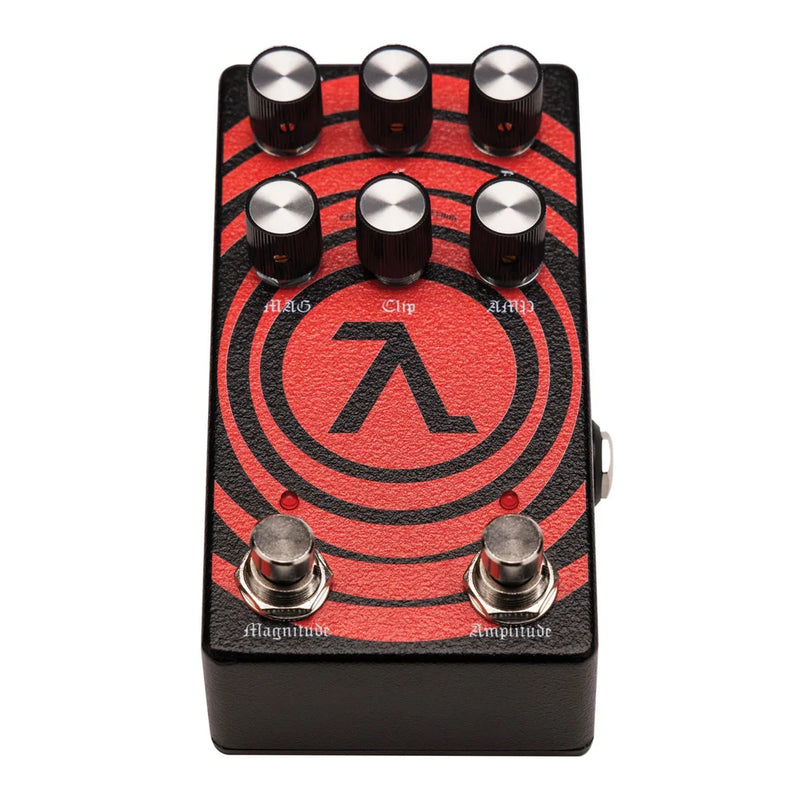

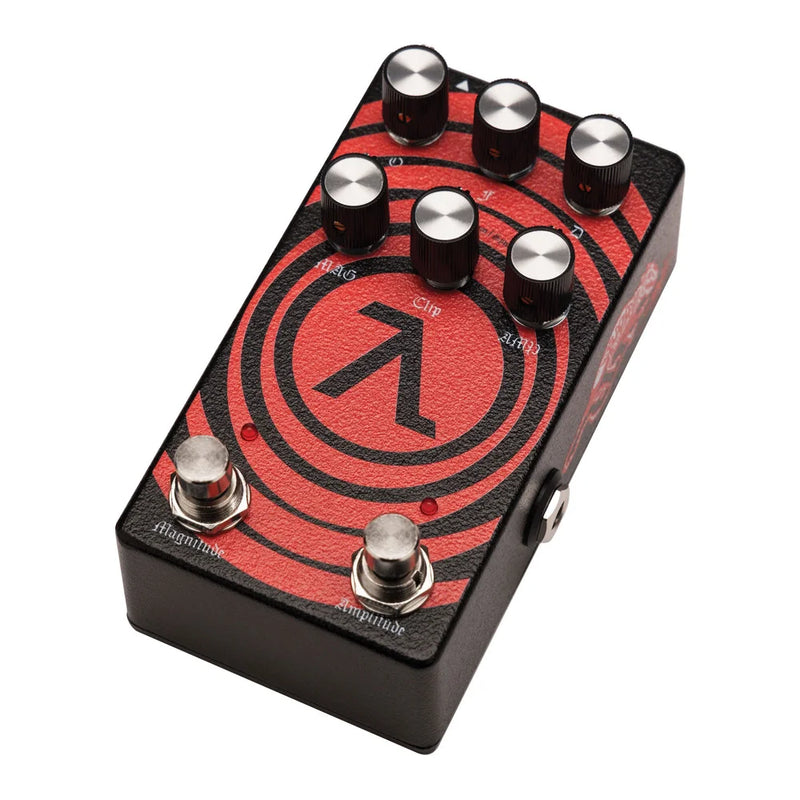

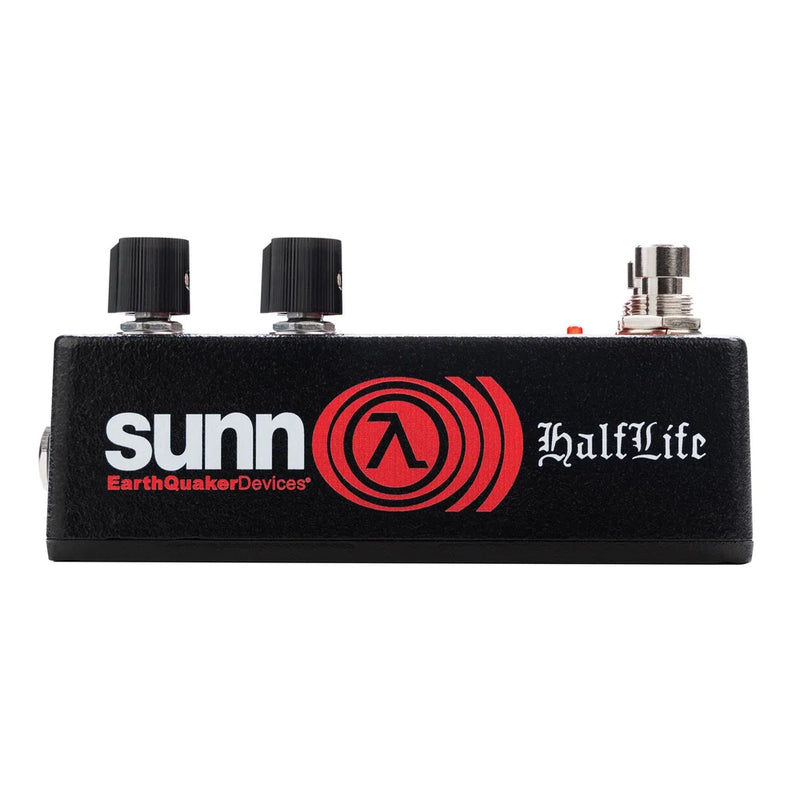
Sunn O))) and EarthQuaker Devices are pleased to present the most compact and pedalboard-friendly version to date of the “Life Pedal” distortion circuit: the Sunn O))) HalfLife Octave Distortion + Booster. Twice as small, just as heavy.
During the recording sessions for the album *Life Metal*, Stephen O’Malley and Greg Anderson worked intensively to sculpt their sound, aiming for a broader energy spectrum based on powerful saturation and exploring a variety of sonic textures. The goal was to make full use of the surgical precision of Steve Albini, the recording engineer on *Life Metal*.
The result is stunning. It reveals remarkable sonic breadth and brightness, vast acoustic cosmos, and bursts of abstract colors—both synthetic and tangible—that emerged from the depths of saturation, at the heart of the interaction between the two musicians and their impressive arsenal of equipment.
Like the “Life Pedal,” the HalfLife reproduces the effects chain used in the recording sessions, designed to push the tubes of vintage Sunn O))) Model T amplifiers (or any other amp of your choice) into a saturated sonic ecstasy. It is the ultimate dream—or the heretical nightmare—of any 100-watt tube amp stack.
An “octave fuzz” effect, inspired by the Shin-Ei FY2 and FY6 units, opens the circuit, followed by brutal distortion—reminiscent of classic “rodent” style pedals—designed with top-quality components and featuring a three-way clipping selector (OpAmp, asymmetrical, and symmetrical). The second stage consists of pure “clean boost,” designed to push the preamp tubes of your vintage system even further, generating rich harmonics and controlled feedback.
The HalfLife is the mass-produced version of the “Sunn O))) HalfLife Fer MMXXV,” a limited edition housed in a cast-iron enclosure made using an ancient Japanese technique called *Nanbu-tekki* (南部鉄器).
The chasms are cleaned, the mountains chiseled, the glaciers calving, novae born. Vintage tube amplifiers recommended. We hope you will reach transcendence.
What is it? Photo by Dan Price
The HalfLife is a pedal that combines, in a compact enclosure, distortion, an analog octave-up effect (blendable), and a booster. The “Magnitude” section faithfully draws inspiration from the famous “White Face” distortion. The only modifications made to the original circuit concern the clipping stage. The traditional circuit uses a single pair of silicon diodes, delivering a tight, compressed “crunch” sound. The HalfLife offers two additional clipping options to best suit your setup: the first position removes the diodes, allowing the full raw, abrasive power of the operational amplifier (Op Amp) to shine through; the second position combines two silicon diodes and one LED in an asymmetrical configuration, producing a smoother, slightly compressed crunch reminiscent of a tube amplifier. Finally, the third position returns to the original two-silicon-diode configuration, delivering the classic sound you know and love.
The HalfLife’s octave effect is based on a discrete-component analog circuit using a full-wave rectifier. Located at the input of the circuit, the “Octave” control allows you to gradually blend in the octave-up effect as you turn the potentiometer to the right. This function can also be controlled via an expression pedal, allowing you to create spectacular octave sweeps while keeping your hands free during your riffs. As it is an analog effect, it is monophonic: it delivers the best results when playing isolated notes above the twelfth fret with the neck pickup selected. Using chords with this effect will produce a dissonant and chaotic result. Conversely, using the bridge pickup and playing below the twelfth fret will keep the octave effect very subtle. When the “Octave” setting is pushed to maximum, the HalfLife transforms: it goes from simple distortion to a wild, harmonically rich fuzz reminiscent of the legendary Super Fuzz!
The “Magnitude” section of the HalfLife is a discrete-component booster based on MOSFET technology, designed to intensely stress the tubes in your preamp. It is a high-impedance, perfectly transparent booster that colors your original signal very little. It does not add distortion on its own, but has enough gain reserve to push your amplifier into saturation.
The signal path is as follows: Octave > Distortion > Boost. The “Octave/Distortion” section and the booster can be used independently, each with its own footswitch. The right switch activates the octave/distortion, while the left switch activates the booster. Controls
Octave (O): Adds an analog octave as you turn the potentiometer clockwise.
Filter (F): This is a low-pass filter with a frequency response ranging from approximately 500 Hz to 30 kHz. Turn counterclockwise to accentuate the high frequencies, and clockwise to attenuate them.
Distortion (D): Turn clockwise to increase the distortion, and counterclockwise to reduce it. This setting offers approximately +60 dB of gain.
Magnitude (MAG): Controls the output volume of the booster. Turn clockwise to make your amp roar; turn counterclockwise if you prefer to play softly. Unity gain is located around noon on the potentiometer.
Clipping selector (CLIP):
OpAmp: No diodes are used, allowing for raw, intense saturation typical of operational amplifiers pushed to maximum volume.
Asymm: Uses two silicon diodes and one LED in an asymmetrical clipping configuration. This produces a slightly compressed, smooth crunch reminiscent of a tube amplifier.
Symm: This is the
Two-silicon-diode configuration, delivering the classic sound you know and love.
Amplitude (AMP): Output volume for the “Octave Distortion” section. Turn clockwise for increased hearing loss; counterclockwise to preserve your hearing at an advanced age.
“Magnitude” footswitch: Activates the boost.
“Amplitude” footswitch: Activates the “Octave Distortion” effect.
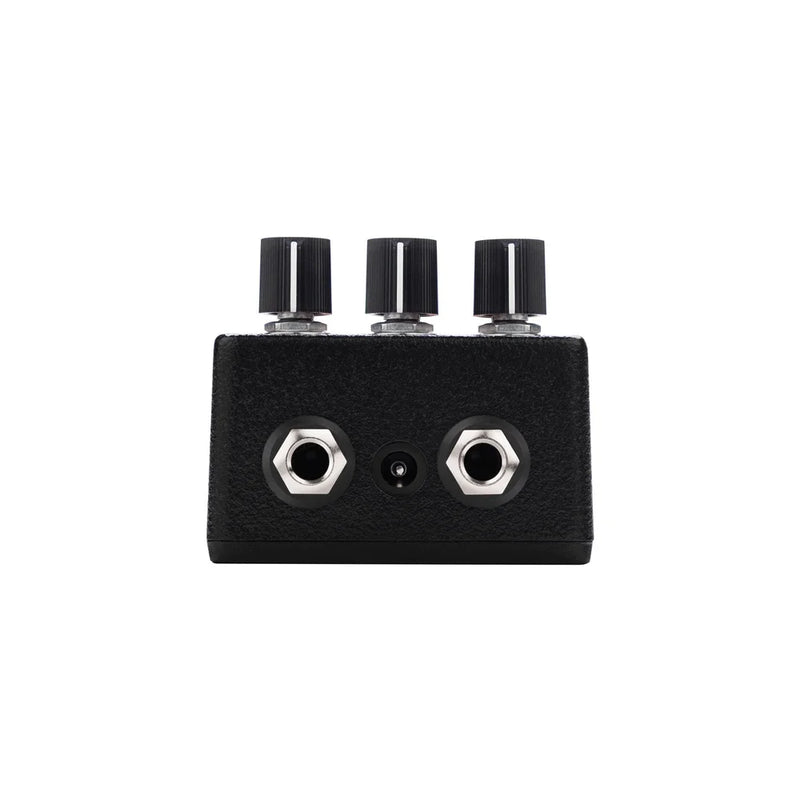
“Octave EXP” input: Allows you to connect an expression pedal to control the analog octave blend.
Dimensions
5.00 × 2.75 × 2.25 inches (127 × 70 × 57 mm), knobs included.
Current draw
15 mA
Octave Distortion
Input impedance: 1 MΩ
Output impedance: <1 kΩ
Booster
Input impedance: 500 kΩ
Output impedance: <1 kΩ
Flexi-Switch® Technology
This device features Flexi-Switch® technology! This relay-based “true bypass” switching system allows you to use momentary and latching switching modes simultaneously.
• For standard operation (latching): press the switch once to activate the effect, and press again to deactivate it (bypass).
• For momentary operation: hold the switch down for as long as you wish to use the effect. As soon as you release the switch, the effect is deactivated.
Because the switching is handled by relays, a power supply is required to allow the signal to pass.
Power Supply
This device requires a standard 9-volt DC power supply, with a 2.1 mm plug and center-negative polarity. We strongly recommend using power supplies designed for effect pedals (equipped with an isolating transformer) or isolated multi-output power supplies. An unstable or “noisy” power supply (exhibiting ripple) will cause unwanted noise. Switching power supplies, daisy chains, or power supplies not designed for effect pedals filter noise less effectively, allowing unwanted noise to pass through. DO NOT USE A HIGHER VOLTAGE!