


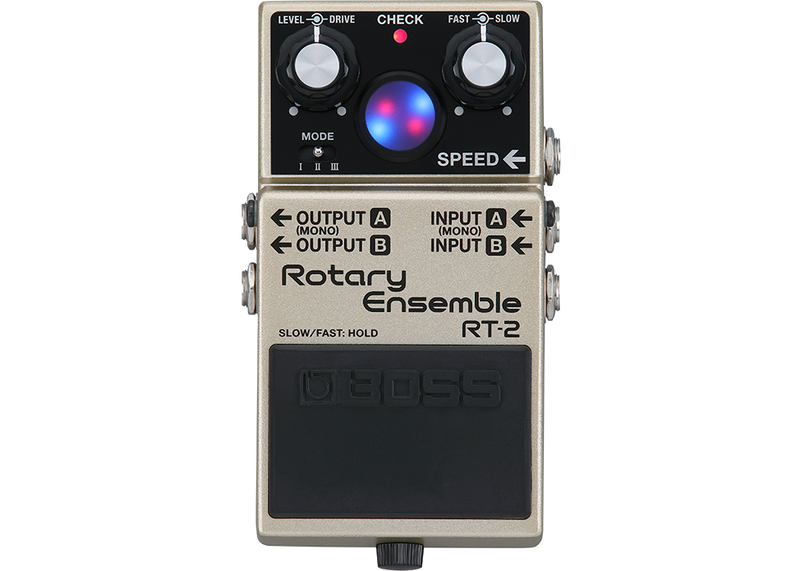
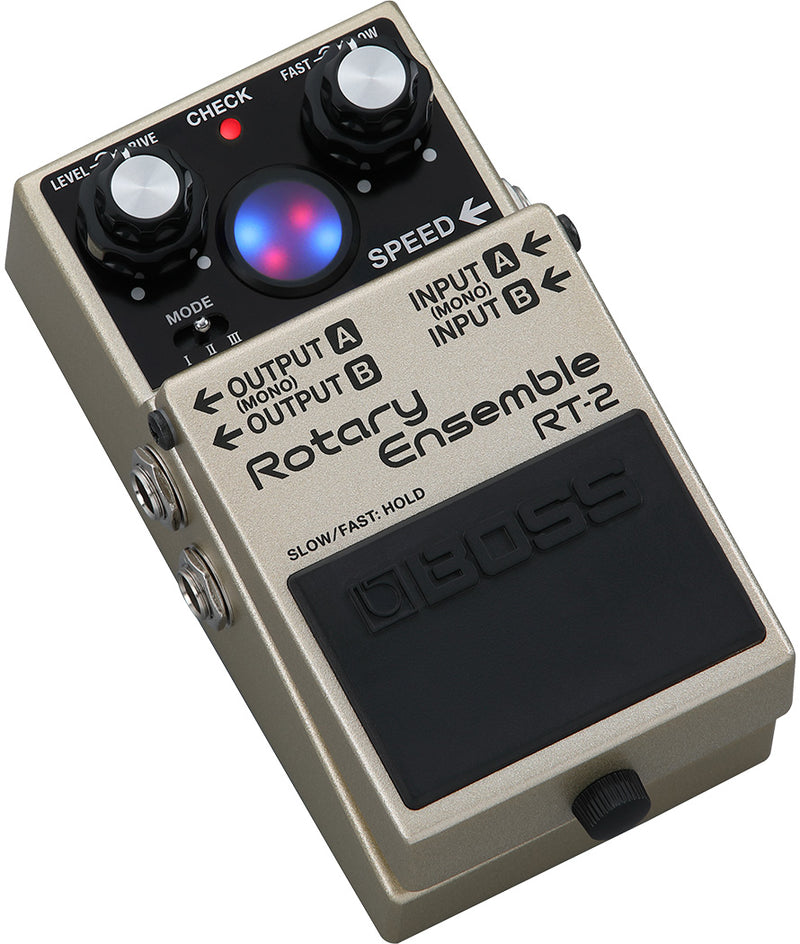
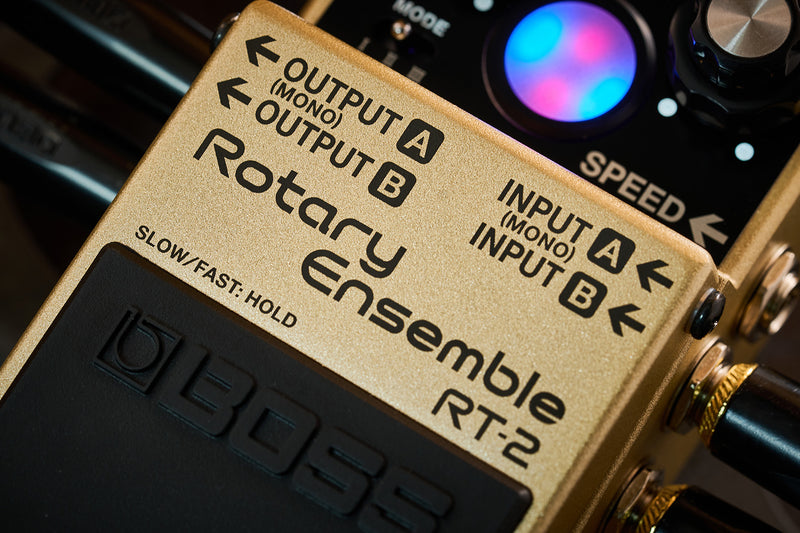
Rotary speakers offer an exceptional sound, but their size and weight make them impractical, except for the most demanding vintage enthusiasts. Equipped with the latest BOSS advancements, the RT-2 Rotary Ensemble distills this expressive spatial effect into a format that is easy to integrate into any setup. This powerful pedal authentically recreates the complex sonic magic of its inspiration, thanks to three sound modes, deep tonal shaping, and advanced operation via the integrated pedal switch and external control.
Features
Authentic rotary speaker sounds and behaviors, condensed into a compact BOSS pedal
Three versatile modes: one vintage rotary sound and two modified sounds with optimized spatial effects
Virtual rotor display with LEDs indicating the speed of the treble and bass rotors
Fast/slow rotor speed control
Drive knob to add vintage tube-style saturation
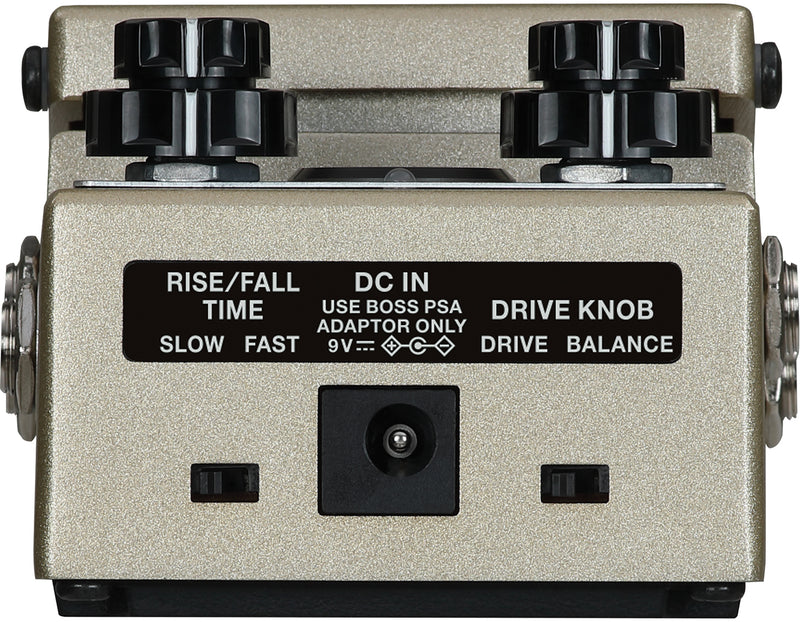
Rise/Fall Time selector to adjust the transition time between rotor speeds
Drive/Balance selector to assign the Drive knob to control either saturation or the volume balance between the treble and bass rotors
Four selectable pedal switch modes to bypass the effect and control rotor speed in various ways while playing
Support for advanced control with external pedals or an expression pedal (speed, brake, and other functions)
Mono/stereo input and output
Two stereo output modes: standard stereo (default) or individual wet and dry outputs
Five-year BOSS warranty
RT-2
Rotary Magic
Originally developed for organs in the 1940s, rotary speakers produce mesmerizing modulation effects with motorized components that rotate at variable speeds within the cabinet. This impressive sound is an essential part of the classic combo organ sound. Guitarists and other musicians have also used rotary speakers to infuse iconic tracks with their characteristic depth and movement.
RT-2
Authentic Performance
The most renowned rotary speakers feature a rotating horn for high frequencies (treble rotor) and a woofer powered by a rotating drum (bass rotor). Changing the rotor speed, between fast and slow, creates a constant flow of tonal variations, long used by musicians to create expressive effects. The RT-2 faithfully reproduces these audio behaviors, thanks to two-way speed control, a rise/fall time switch to adjust the transition time between speeds, and a colored indicator showing the current rotation of the virtual rotors.
RT-2
Three Versatile Tones
Use the RT-2's three-position mode selector to activate the classic rotary speaker sound and two modern variants developed with custom BOSS tuning.
Mode I: Faithful reproduction of the most famous vintage rotary speaker model, realized with the latest BOSS modeling technology. This mode adds the traditional color of rotary speakers to all instruments, from guitar and bass to organs, electric pianos, synthesizers, and more.
Mode II: Vintage rotary speaker sound, enriched with a wider tonal range. This mode offers increased spatial performance in combination with overdrive and distortion pedals.
Mode III: Enhanced definition through intense modulation and drive settings, adding power and presence to arpeggios and solos.
RT-2
Vintage Saturation and Tonal Balance
Inspired by the tube amplifier circuits of vintage rotary speakers, the RT-2's Drive knob allows you to add pleasant distortion to the sound, from smooth to gritty. Thanks to a switch located on the back, this dual-function knob can alternatively adjust the volume balance between the treble and bass rotors to achieve different tonal characteristics. Your latest drive and balance settings are automatically saved in memory and recalled instantly the next time the unit is powered on.
RT-2
Deep Expressive Control
Real-time speed control is essential to the rotary experience, and the RT-2 offers numerous options to achieve it. The pedal offers four operating modes, with plenty of tricks to bypass the effect and change speed while you play. You can also connect up to two external pedals for independent speed control and access a "brake" setting that stops the virtual rotors at their current position for unique sonorities. An expression pedal also allows for continuous control of level, dynamics, balance, and speed, with assignable settings for each parameter.